French Culture and Etiquette: A Cultural Translator’s Guide to Navigating France with Grace
Growing up in Lyon’s historic Presqu’île district, I watched my American and British neighbors commit the same cultural missteps repeatedly—greeting shopkeepers with silence, arriving precisely on time to dinner parties, wearing athletic shoes to evening restaurants. They were kind, intelligent people who simply didn’t understand that French culture and etiquette operates on unspoken rules that native French absorb from childhood but remain invisible to visitors.
After two decades working as a cultural journalist for Le Monde and now bridging French and international perspectives, I’ve realized something essential: understanding French culture and etiquette isn’t about memorizing arbitrary rules or transforming yourself into a pseudo-Parisian. It’s about recognizing the philosophy underlying French social behavior—a complex dance of respect, privacy, formality, and paradoxical warmth that shapes every interaction from bakery transactions to business meetings.
The French relationship with etiquette reveals something fundamental about our culture. We’re not cold or rude, as the stereotype suggests. We’re simply operating within a different social framework where privacy is treasured, formality signals respect, and directness demonstrates honesty. Once you understand the “why” behind the “what,” navigating French culture and etiquette becomes intuitive rather than intimidating. Let me show you how to move through France with confidence, respect, and the understanding that transforms tourists into temporary cultural participants.
Understanding French Culture and Etiquette: The Philosophical Foundation
Before we discuss specific behaviors, you must understand the cultural values that shape French culture and etiquette. These aren’t arbitrary customs—they’re expressions of deeply held beliefs about human interaction, public versus private life, and what constitutes respect.
The Public-Private Divide: France’s Invisible Wall
French culture draws a sharp distinction between public and private spheres that most Anglo-Saxon cultures don’t maintain. This boundary explains countless behaviors that confuse visitors.
In public spaces—streets, shops, restaurants, public transportation—the French maintain formal distance. We don’t smile at strangers, make small talk in elevators, or share personal information with shopkeepers. This isn’t coldness; it’s respecting the privacy barrier. Public space is neutral territory where we conduct necessary transactions efficiently and politely, but without false intimacy.
Private space—homes, close friendships, family gatherings—operates completely differently. Once you’ve been invited across the threshold into private French life, warmth, generosity, and deep conversation flow freely. The contrast startles many visitors: the formal shopkeeper becomes an animated dinner companion; the reserved colleague transforms into a passionate conversationalist over wine.
This divide shapes French culture and etiquette fundamentally. What Americans or British might see as friendliness—casual greetings, immediate first-name basis, quick invitations—the French interpret as superficiality. True friendship requires time, mutual respect demonstrated through proper etiquette, and the gradual lowering of formal barriers.
Formality as Respect, Not Distance
French culture and etiquette employs formality to signal respect, not to create distance. The formal “vous” form, titles, structured greetings—these aren’t barriers but acknowledgments of the other person’s dignity and autonomy.
Consider the daily greeting ritual. When entering a shop, restaurant, or even an elevator with only one other person, the French say “bonjour” (before noon) or “bonsoir” (after 6 PM). This isn’t pointless ceremony—it’s acknowledging the other person’s existence, their right to courtesy, their humanity. The absence of greeting suggests you view them as beneath notice, which is profoundly disrespectful in French cultural logic.
The transition from “vous” to “tu” (informal you) represents significant relationship evolution. In professional contexts, colleagues might work together for years while maintaining “vous.” When someone suggests switching to “tu” (tutoyer), it signals genuine friendship and intimacy. This gradual progression allows relationships to develop authentically rather than forcing premature familiarity.
Directness and Intellectual Honesty
The French value directness in a way that can shock cultures accustomed to softening criticism or disagreement. This directness isn’t rudeness—it’s intellectual honesty.
In French culture, disagreeing with someone’s ideas while maintaining respect for the person demonstrates that you take them seriously. The Anglo-American habit of prefacing criticism with excessive compliments or hedging disagreement with phrases like “I could be wrong, but…” strikes the French as insincere or intellectually timid.
Understanding this aspect of French culture and etiquette prevents misinterpreting passionate debate as personal attack. When French colleagues argue intensely about politics, philosophy, or the correct way to make vinaigrette, they’re not fighting—they’re engaging in the French national sport of intellectual discourse. The conversation ends, everyone orders another bottle of wine, and the relationships remain intact because ideas were debated, not people attacked.
Quality Over Convenience: The French Temporal Philosophy
French culture prioritizes quality of experience over speed or convenience. This manifests in long lunches, shops closing for midday breaks, resistance to Sunday opening hours, and the sacred two-hour dinner.
This isn’t inefficiency or laziness—it’s a deliberate choice about what constitutes a life well-lived. The French believe that rushing through meals, eliminating rest periods, and prioritizing productivity over presence diminishes human experience. This philosophy shapes French culture and etiquette around meals, working hours, and social interactions.
When traveling in France, you’ll encounter this constantly: the shop that closes 12:30-2:30 PM for lunch, the restaurant that won’t rush your table, the café where you can sit for hours over a single coffee without pressure to order more or leave. This isn’t customer service failure—it’s a different value system where human rhythms matter more than commercial efficiency.
French Culture and Etiquette in Daily Interactions: Practical Applications
Now that you understand the philosophical foundation, let’s explore how French culture and etiquette manifests in specific situations you’ll encounter while traveling.
Greetings: The Foundation of All French Interactions
Proper greetings represent the cornerstone of French culture and etiquette. Master these, and you’ve taken the most important step toward positive French interactions.
The basic greeting formula:
- Morning to noon: “Bonjour, madame/monsieur”
- Afternoon/evening: “Bonsoir, madame/monsieur”
- Departure: “Au revoir, madame/monsieur” or “Bonne journée/soirée”
When to greet:
- Entering any shop, restaurant, or business
- Making eye contact with someone in an elevator or small space
- Approaching someone for assistance or directions
- Beginning any transaction or interaction
The kiss (la bise): French people greet friends and family with cheek kisses. The number varies by region—two in Paris, three in Provence, four in some areas. As a visitor, don’t initiate la bise. If French acquaintances initiate it, follow their lead. Actual lip contact with cheeks isn’t necessary—often it’s cheek-to-cheek with kissing sounds.
The handshake: In professional contexts or when meeting someone for the first time, a firm (but not crushing) handshake while making eye contact is appropriate. French handshakes are brief—one or two pumps, not the extended grip common in some cultures.
What confuses visitors: The French don’t greet strangers on streets or hiking trails the way some cultures do. A street greeting would be overly familiar and invade privacy. But in contained spaces like shops or elevators, the greeting acknowledges shared space temporarily.
Shopping Etiquette: Respecting the Ritual
French shopping, particularly in small shops and markets, follows protocols that honor both merchant and customer. Understanding these aspects of French culture and etiquette transforms potentially awkward interactions into pleasant exchanges.
Entering a shop:
- Make eye contact with the shopkeeper
- Say “Bonjour, madame/monsieur”
- Wait for their response before browsing or stating your need
- If someone is being served, wait your turn without interrupting
Browsing and asking for help:
- It’s perfectly acceptable to browse without buying, but acknowledge the shopkeeper
- When you need assistance: “Excusez-moi, madame/monsieur…”
- Don’t touch products without permission in small shops, especially food items
- In markets, vendors often prefer to select produce for you (ensuring quality and fairness)
Making purchases:
- Have small bills and coins ready (many small shops can’t break large notes)
- Place money in the shopkeeper’s hand or the small tray they provide (not on counter)
- Wait for them to give you change directly (don’t grab it)
- Say “Merci, au revoir” when leaving
Markets: French markets have their own sub-culture within French culture and etiquette. Arrive with your own bags, greet each vendor you interact with, don’t squeeze produce, and remember that vendors take pride in selecting the best items for you. Asking to pick your own fruits implies you don’t trust their judgment—a subtle insult.
Supermarkets: More relaxed than small shops, but still greet cashiers and bag your own groceries quickly (people behind you are waiting). In some supermarkets, you’ll need to weigh and price produce yourself in the produce section.
Restaurant Etiquette: The Sacred French Meal
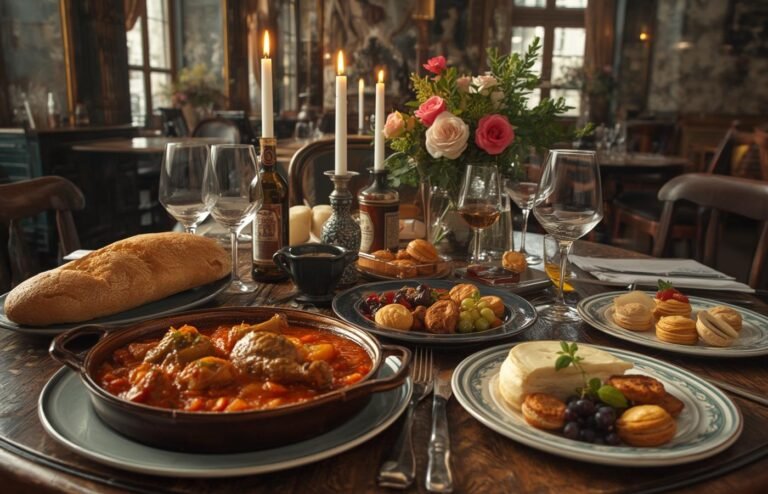
Dining represents one of the most important aspects of French culture and etiquette. The French approach meals as cultural experiences, not mere fuel consumption, and restaurant customs reflect this philosophy.
Entering and seating:
- Wait to be seated in all but the most casual establishments
- Greet the host/server: “Bonjour/Bonsoir, madame/monsieur”
- Don’t seat yourself or move tables without permission
- If a restaurant appears full, ask “Avez-vous une table?” (Do you have a table?) rather than assuming
Understanding French meal structure:
- Apéritif: Pre-meal drinks (optional)
- Entrée: Starter/appetizer (not the main course!)
- Plat principal: Main course
- Fromage: Cheese course (traditional, less common in casual restaurants)
- Dessert: Sweet conclusion
- Café: Coffee (always after dessert, never during)
- Digestif: After-dinner drink (optional)
Ordering and dining pace:
- Take time reviewing the menu—rushing signals disrespect for the meal
- Ask questions about dishes politely: “Pourriez-vous me conseiller?” (Could you advise me?)
- Don’t expect substitutions or modifications (French cuisine emphasizes chef’s vision)
- The meal progresses at a relaxed pace—servers won’t rush you
- Don’t ask for the check until you’re truly ready to leave
Table manners:
- Keep hands visible on the table (but not elbows)
- Rest fork tines down between bites (American style of switching hands appears awkward)
- Break bread with hands; don’t cut it with a knife
- Never cut salad leaves with knife—fold them with fork
- Finish everything on your plate (leaving food suggests it wasn’t good)
- Don’t discuss diets, calories, or food restrictions unless medically necessary
The check:
- Signal you want the check: “L’addition, s’il vous plaît”
- The server will bring it to the table; they never rush you
- Check is usually presented in a small folder
- Tipping: Service is included (15% by law), but rounding up or leaving 5-10% for exceptional service is appreciated
- Split checks are uncommon—expect to divide the total yourselves
Water and bread:
- Tap water (carafe d’eau) is free and perfectly safe—don’t feel pressured to order bottled water
- Bread comes automatically and is free—use it to push food onto fork, not as a meal itself
- Bread plates don’t exist in traditional French dining—place bread directly on tablecloth
Café Culture: Understanding the Living Room of France
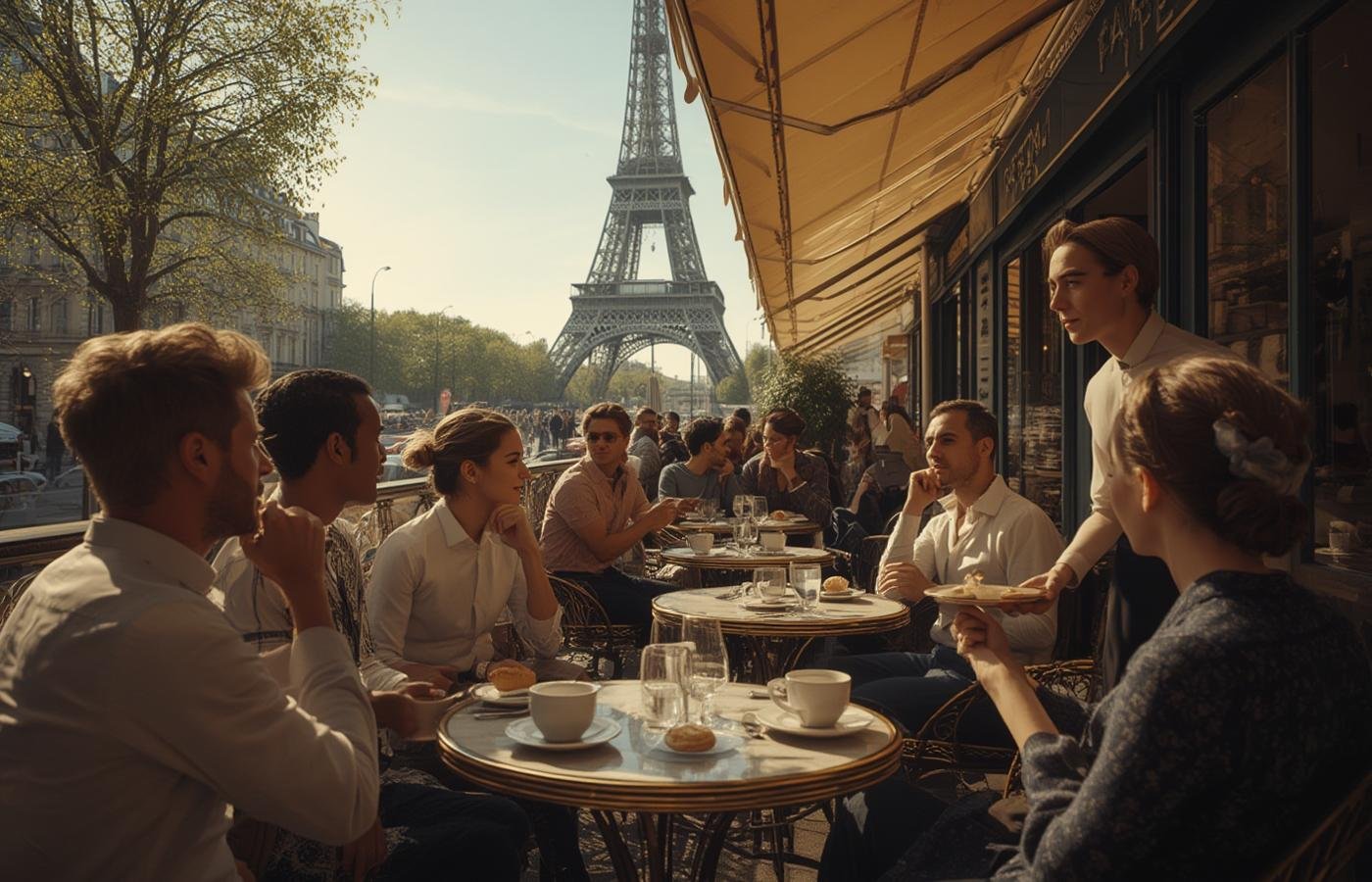
Cafés function as France’s public living rooms, governed by their own subset of French culture and etiquette. The café represents where private French life occasionally becomes semi-public.
Café protocols:
- Seat yourself at any available table (terraces have best people-watching but cost more)
- Wait for server to approach—don’t go to the bar unless you’re ordering au comptoir (at the counter, cheapest option)
- Order decisively when server arrives (they’re usually busy)
- You’re paying for the table, not just the drink—no one will pressure you to leave
- Order additional drinks when you want them; server won’t check constantly
What to order:
- Morning: Café (espresso), café crème (with milk), café allongé (americano)
- Afternoon/evening: Wine, beer, apéritif (Kir, pastis)
- Food: Simple offerings—croissants in morning, croque-monsieur, salads
Café reading and working: It’s completely acceptable to spend hours with a book or laptop over a single drink. This is culturally normal behavior, not freeloading. The café offers space for contemplation, observation, and gentle solitude in public.
Smoking: Smoking is prohibited inside but common on terraces. If smoke bothers you, sit inside or accept that terrace life includes cigarette culture.
French Culture and Etiquette in Social Situations: Navigating French Hospitality
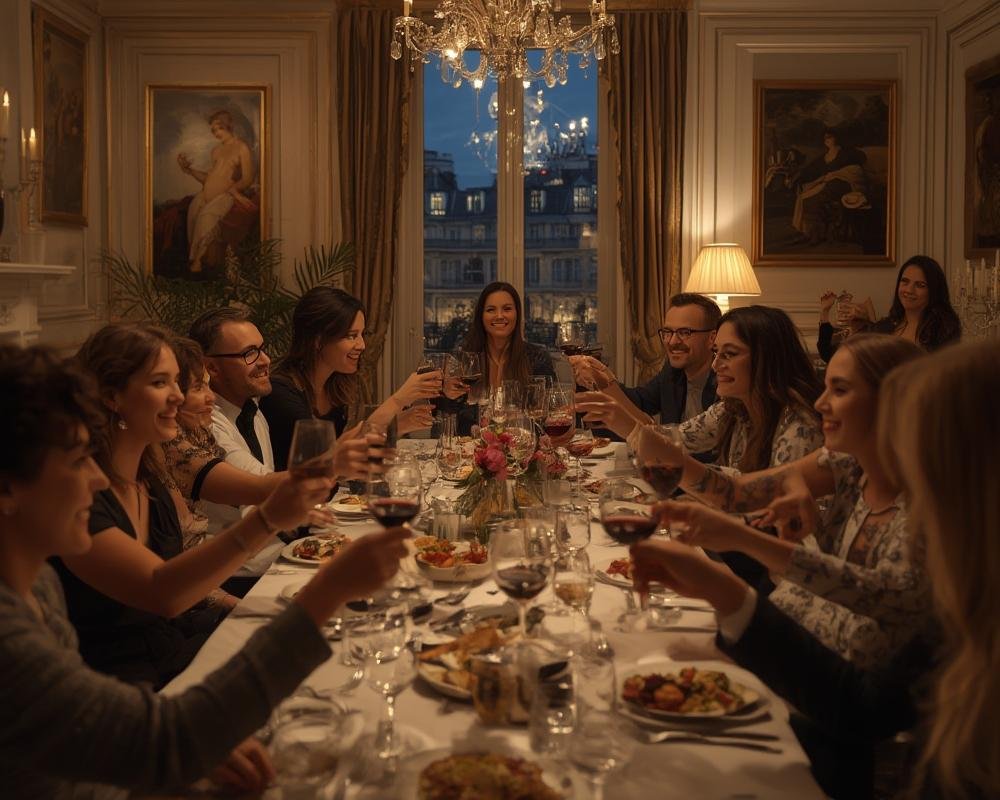
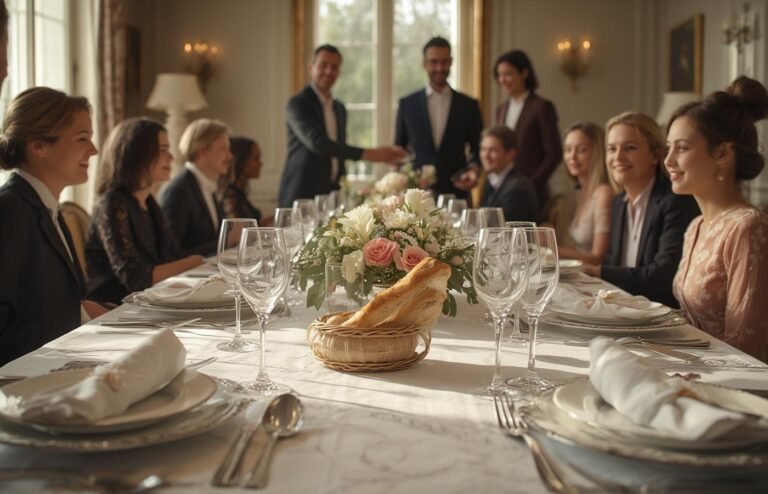
Being invited into private French spaces—homes, dinner parties, social gatherings—represents crossing the public-private threshold. This honor comes with specific expectations within French culture and etiquette.
Dinner Party Etiquette: The Height of French Social Art
French dinner parties operate according to elaborate but unwritten rules. These guidelines help you navigate this important aspect of French culture and etiquette successfully.
Timing paradox:
- Arrive 10-15 minutes late (never early, never on time)
- This lateness (le quart d’heure de politesse—the polite quarter-hour) allows hosts final preparations
- Arriving exactly on time suggests you’re overeager or inflexible
- More than 20 minutes late requires a phone call with explanation
Gifts for hosts:
- Bring flowers (but not chrysanthemums—they’re for cemeteries, or red roses—they’re romantic)
- Wine is tricky—bring good wine, but don’t expect it to be served that evening (it implies you don’t trust host’s selection)
- Chocolates or specialty items from your country work well
- Present gifts to the hostess, not opened immediately
Aperitif period:
- Guests gather for pre-dinner drinks and light conversation
- This can last 30-60 minutes—don’t expect to eat immediately
- Accept offered drinks graciously
- Make polite conversation with all guests, not just those you know
Seating:
- Wait to be told where to sit
- Couples are usually separated
- Guest of honor sits to host’s right
Conversation:
- French dinner conversation values intelligence, wit, and spirited debate
- Politics, philosophy, culture, art—all acceptable topics
- Personal finance, salaries, costs—inappropriate topics
- Religion can be discussed intellectually but not devotionally
- Passionate disagreement is normal—don’t take it personally
- Listen actively and contribute thoughtfully
Table manners at home:
- Similar to restaurant etiquette but more relaxed
- Compliment the food sincerely and specifically
- Take moderate portions initially (seconds may be offered)
- Participate in all courses even if you’re full
- Never start eating before the hostess begins
- Rest cutlery parallel on plate when finished (pointing to 10:20 on clock face)
Duration:
- French dinner parties last 3-5 hours minimum
- Leaving before coffee and digestifs is rude unless you’ve explained in advance
- The first guests to leave signal general departure—don’t be the first to go
Thank you:
- Thank hosts warmly upon leaving
- Send a follow-up text or email the next day expressing appreciation
- A handwritten note is elegant but increasingly rare
French Friendship: Slow Development, Deep Loyalty
Understanding how French friendships develop helps contextualize aspects of French culture and etiquette that can seem cold initially.
The progression:
- Initial encounters remain formal (vous, titles, polite distance)
- Multiple pleasant interactions build mutual respect
- Eventually, one person proposes tu (“On peut se tutoyer?”)
- Invitations progress from café meetings to home dinners
- True friendship takes months or years to establish
What this means for travelers: The French won’t become instant best friends, but they’ll provide excellent service, helpful directions, and respectful interactions. Don’t interpret formality as rejection—it’s simply the French way of navigating public space while reserving private warmth for established relationships.
Building connections as a visitor:
- Learn basic French and use it (effort matters more than perfection)
- Show genuine interest in French culture, history, art
- Engage intellectually—ask thoughtful questions
- Respect boundaries—don’t push for immediate intimacy
- Return to the same cafés, shops, markets—recognition builds rapport
French Culture and Etiquette Across Regions: France Is Not Monolithic
French culture and etiquette varies significantly by region. While certain principles remain consistent nationwide, regional variations shape daily interactions.
Paris: The Formal Center
Parisian French culture and etiquette tends toward maximum formality. Parisians maintain strict public-private boundaries, value efficiency in transactions, and have little patience for tourists who don’t make basic linguistic efforts.
Parisian specifics:
- Greetings are essential but brief
- Customer service appears brusque by international standards (it’s not personal)
- Dress is generally more formal and fashionable
- Metro etiquette: Don’t make eye contact, don’t talk loudly, give up seats for elderly/pregnant women
- Tipping culture is most developed here
Don’t take it personally: Paris moves fast, serves millions of tourists annually, and maintains protective formality. This doesn’t represent all of France.
The South: Warmer Relations, Slower Pace
Southern France—Provence, Côte d’Azur, Languedoc—exhibits more relaxed French culture and etiquette with Mediterranean influences.
Southern differences:
- Greetings are warmer, conversations longer
- Shop closures for lunch are longer and more sacred
- Afternoon sieste culture persists
- Dress codes are more casual
- People are generally more patient with tourists
The southern approach to time reflects Mediterranean philosophy—relationships and quality of life matter more than efficiency.
Brittany and Normandy: Reserved North
Northwestern France maintains reserved, polite interactions similar to northern European cultures.
Northern characteristics:
- Formal greetings remain important
- Personal space boundaries are even more pronounced
- Weather-related small talk is acceptable (unlike Paris)
- Less demonstrative than the south but equally welcoming once trust is established
Alsace: German Influences
Alsace’s German heritage shapes its version of French culture and etiquette.
Alsatian distinctions:
- Punctuality matters more than elsewhere in France
- Efficiency and organization are valued
- Christmas markets represent significant cultural tradition
- Bilingual culture (Alsatian dialect and French) creates unique identity
Lyon and the East: Gastronomic Tradition
Lyon, France’s gastronomic capital, centers much of its culture around food.
Lyonnais specifics:
- Food quality is taken extremely seriously
- Traditional bouchons (small restaurants) have their own rituals
- Wine knowledge is assumed and appreciated
- More bourgeois formality than Paris but warmer than stereotypes suggest
Language and Communication: Essential Elements of French Culture and Etiquette
Language represents far more than communication in French culture—it’s intimately connected to identity, respect, and social positioning. This aspect of French culture and etiquette deserves careful attention.
The Effort Principle: Why French Appreciate Attempts
The French genuinely appreciate visitors who attempt French, even poorly. This isn’t about fluency—it’s about respect. Speaking English in France without first attempting French implies either arrogance (expecting the world to speak your language) or disrespect (not bothering to learn basic phrases).
Essential phrases:
- Bonjour/Bonsoir, madame/monsieur: Hello (before noon/after 6 PM)
- Parlez-vous anglais?: Do you speak English?
- Je ne parle pas bien français: I don’t speak French well
- Excusez-moi: Excuse me
- S’il vous plaît: Please
- Merci beaucoup: Thank you very much
- Au revoir: Goodbye
- Je voudrais…: I would like…
- L’addition, s’il vous plaît: The check, please
- Où sont les toilettes?: Where are the restrooms?
The protocol:
- Always greet in French first
- Ask politely if they speak English: “Parlez-vous anglais?”
- If they do, thank them: “Merci” and switch to English
- If they don’t, attempt French or use translation apps
- Always end interactions in French: “Merci, au revoir”
This sequence demonstrates respect for French as the country’s language while acknowledging your linguistic limitations. The French respond positively to this effort, often helping you with vocabulary or switching to English if they can.
Vous vs. Tu: Understanding French Formality
The formal (vous) and informal (tu) distinctions represent crucial elements of French culture and etiquette.
Use vous with:
- Anyone you don’t know personally
- Shop workers, servers, hotel staff
- Professional contacts
- Older people
- Anyone in a position of authority
Use tu with:
- Children
- Close friends
- Family
- People who’ve specifically said “On peut se tutoyer?” (Can we use tu?)
Never initiate tu: Let French people suggest the transition. Using tu prematurely is overly familiar and disrespectful. Even after years of professional relationships, some French colleagues maintain vous.
Topics of Conversation: What’s Appropriate in French Culture and Etiquette
French conversational norms differ from Anglo-American patterns.
Welcome topics:
- Politics (expect passionate debate)
- Philosophy and ideas
- Art, literature, cinema
- Food and wine (with knowledge and appreciation)
- Travel and cultural observations
- History and architecture
- Current events and social issues
Avoid topics:
- Personal income or costs
- Religious belief (as opposed to intellectual discussion of religion)
- Your own accomplishments (humility is valued)
- Complaints about France (save these for after you’ve established trust)
- Diet culture or health obsessions
- Work as your identity (the French separate work from personhood)
Conversation style: The French value articulate, thoughtful discourse. They’re comfortable with silence while formulating thoughts, direct disagreement, and intellectual rigor. What might seem like arguing to Americans is often just engaged French conversation.
Dress Codes and Appearance: Visual Elements of French Culture and Etiquette
The French phrase “s’habiller” (to dress oneself) carries cultural weight. Appearance represents respect for others and situations, not vanity.
General Principles of French Dress
Quality over quantity: The French buy fewer items of higher quality, creating versatile wardrobes of well-made pieces.
Appropriate formality: The French dress for occasions—casual for markets, refined for restaurants, elegant for theater or opera.
Understated elegance: Avoid logos, bright colors, athletic wear as street clothes, or anything that screams “tourist.”
Neutral palette: Black, navy, gray, beige, white dominate French wardrobes, with occasional color accents.
Specific Contexts
City exploration:
- Men: Dark jeans or trousers, collared shirt or quality t-shirt, leather shoes or minimal sneakers
- Women: Dark jeans or trousers, blouse or quality top, flats or low heels, simple scarf
- Both: Avoid athletic shoes, shorts (except in summer heat), flip-flops, visible athletic wear
Restaurants (mid-range to upscale):
- Men: Trousers, button-down shirt or polo, closed shoes, optional blazer
- Women: Dress, skirt, or elegant trousers with blouse, closed shoes, minimal jewelry
- Both: No shorts, t-shirts, athletic wear, or sandals
Religious sites:
- Covered shoulders and knees required
- Remove hats inside
- Quiet, respectful behavior
- Photography often restricted
Beach and resort areas:
- More casual dress acceptable
- Swimwear stays on the beach (not for walking streets or markets)
- Cover-ups required in restaurants and shops
Business settings:
- Conservative, formal dress
- Men: Suit and tie standard
- Women: Suit, dress, or separates, closed-toe shoes
- Quality accessories matter
What Marks You as American/British Tourist
Certain clothing choices immediately identify tourists and can invite negative treatment within French culture and etiquette expectations:
- White athletic shoes (especially chunky sneakers)
- Shorts with athletic shirts
- Baseball caps
- College/sports team clothing
- Cargo shorts or pants
- Flip-flops outside beach areas
- Visible camera equipment
- Fanny packs or large backpacks
Business Culture: French Culture and Etiquette in Professional Contexts
French business culture maintains distinct characteristics shaped by educational system, labor laws, and cultural values.
Meetings and Professional Interactions
Formality:
- Always use vous until explicitly told otherwise
- Use titles (Monsieur/Madame + last name, or professional titles)
- Business cards exchanged formally with brief acknowledgment
- Meetings start with brief personal rapport-building, then shift to business
Hierarchy:
- French companies tend toward hierarchical structures
- Decisions come from top-down
- Respect for authority and credentials matters
- Educational background (especially grandes écoles) influences career trajectory
Communication style:
- Direct communication valued
- Disagreement expressed openly
- Intellectual debate is normal and expected
- Written communication is formal and well-structured
- Email greetings and closings are elaborate (Cordialement, Bien à vous)
Meetings:
- Punctuality is expected for business (unlike social events)
- Agendas followed more flexibly than in Anglo-Saxon cultures
- Long lunches are standard (1.5-2 hours)
- Business lunches focus on relationship-building first, business second
Work-life balance:
- 35-hour work week is standard
- Five weeks paid vacation is minimum
- Work emails after hours or on weekends are discouraged
- Professional and personal lives remain more separate than in U.S.
Understanding French Labor Culture
French labor laws and worker protections shape business interactions within French culture and etiquette frameworks:
- Unions remain powerful
- Job security is highly valued
- Strikes (grèves) are common and socially acceptable
- Work is not identity—the French value personal life equally or more
- Efficiency matters, but not at the cost of quality or worker welfare
Common Mistakes Visitors Make with French Culture and Etiquette
Let me share the most frequent cultural missteps I observe, and more importantly, how to avoid them.
Speaking English Without Attempting French First
The mistake: Walking into shops or restaurants and immediately speaking English.
Why it’s problematic: It suggests you expect everyone to speak your language and haven’t bothered learning basic French phrases.
The solution: Always start with “Bonjour, parlez-vous anglais?” before switching to English.
Smiling at Everyone
The mistake: American-style friendly smiling at strangers on streets or métro.
Why it’s problematic: Random smiling at strangers seems suspicious or suggests romantic interest.
The solution: Smile in appropriate contexts (when greeted, during transactions, with children) but maintain neutral expression in anonymous public spaces.
Eating on the Go
The mistake: Walking while eating, especially in cities.
Why it’s problematic: Eating represents a moment of focus and pleasure, not multitasking. Walking while eating appears uncivilized.
The solution: If you’re in a hurry, eat standing still, ideally leaning against a wall or sitting on a bench. Better yet, make time to sit down.
Asking “How Are You?” as Greeting
The mistake: Using “Comment allez-vous?” (How are you?) as a casual greeting.
Why it’s problematic: This is a genuine question in French, not a greeting ritual. People will actually tell you how they are, in detail.
The solution: Stick with “Bonjour/Bonsoir”. Reserve “Comment allez-vous?” for people you actually know and genuinely want to hear from.
Discussing Money or Costs
The mistake: Talking about how much things cost, your salary, or financial matters in conversation.
Why it’s problematic: Money talk is considered vulgar and gauche in French society.
The solution: Avoid discussing personal finances, prices, or costs unless absolutely necessary for practical transaction.
Arriving On Time to Dinner Parties
The mistake: Showing up exactly when invited.
Why it’s problematic: Hosts need buffer time for final preparations; punctuality suggests inflexibility.
The solution: Arrive 10-15 minutes late. For larger parties, 15-20 minutes late is acceptable.
Overdressing or Underdressing
The mistake: Wearing athletic clothes for city exploration or being too casual in restaurants.
Why it’s problematic: Appropriate dress shows respect for context and others.
The solution: When in doubt, err on the side of slightly more formal. Observe what French people wear and adjust accordingly.
Not Greeting Shop Workers
The mistake: Entering shops silently or while on phone, grabbing what you need, and checking out without greeting.
Why it’s problematic: Failing to greet someone in their space is profoundly disrespectful in French culture and etiquette.
The solution: Put phone away, make eye contact, say “Bonjour” when entering, and “Au revoir” when leaving. Even in supermarkets, greet your cashier.
Asking for Substitutions or Modifications in Restaurants
The mistake: Requesting menu items without certain ingredients or prepared differently.
Why it’s problematic: It suggests you know better than the chef and disrespects their culinary vision.
The solution: If you have serious allergies, explain politely. Otherwise, order something else or try the dish as prepared.
Being Loud in Public
The mistake: Loud conversations, laughter, or phone calls in public spaces.
Why it’s problematic: The French value discretion in public; loudness invades others’ privacy.
The solution: Moderate your volume. Notice how quietly French people speak in restaurants, métro, or streets, and match that level.
Regional Variations in French Culture and Etiquette: Beyond Stereotypes
France’s diversity means French culture and etiquette manifests differently across regions. Understanding these variations prevents overgeneralizing based on Paris experiences.
Parisian Exceptionalism
Paris is France, but France is not Paris. Parisians represent maybe 15% of French people and exhibit the most formal, rushed, and stereotypically “rude” behavior. Other regions often actively distinguish themselves from Parisian attitudes.
What’s different elsewhere:
- Slower pace of life
- More willingness to help tourists
- Less multilingual population (more patient with language struggles)
- More authentic expressions of regional culture
- Less expensive everything
- More genuine warmth once trust is established
The Midi and Mediterranean Culture
Southern France incorporates Mediterranean cultural influences that soften some formal aspects of French culture and etiquette:
- Louder, more animated conversation acceptable
- Physical gestures and expressions more common
- Lunch breaks can extend to three hours
- Sieste culture persists in smaller towns
- Evening meals start later (9 PM or after)
- Beach culture introduces more casual dress codes
Celtic and Breton Identity
Brittany maintains distinct cultural identity with its own language (Breton) and customs:
- Proud regional identity distinct from “French”
- Reserved but friendly demeanor
- Maritime culture shapes food and lifestyle
- Traditional festivals (fest-noz) maintain Celtic heritage
- More similar to Welsh or Irish temperament than stereotypical French
Alsace’s Germanic Heritage
Alsace’s complex history between France and Germany creates hybrid culture:
- Punctuality valued more than elsewhere in France
- Christmas traditions are elaborate and important
- Cleanliness and order emphasized
- Wine culture distinct from rest of France
- Bilingual signage and cultural identity
Basque Country’s Independent Spirit
The French Basque region shares culture with Spanish Basque Country:
- Distinct language (Euskara) and cultural identity
- Strong sense of regional pride
- Food culture emphasizes pintxos and Basque specialties
- Surf culture along coast
- More casual, outdoor-oriented lifestyle
Adapting Your Behavior: Practical Strategies for Embracing French Culture and Etiquette
Understanding French culture and etiquette intellectually differs from successfully implementing it. Here are practical strategies for adaptation.
The First 48 Hours: Establishing Good Patterns
Your first interactions set the tone for your entire trip. Focus on these priorities:
Day One:
- Practice greetings obsessively (Bonjour, madame/monsieur)
- Slow down your walking pace to match French rhythms
- Observe how French people interact in shops, cafés, streets
- Don’t expect things to happen quickly (banks, post offices, restaurants)
- Dress slightly more formally than comfortable
Day Two:
- Return to the same café or bakery—recognition builds rapport
- Attempt small conversations in French (weather, recommendations)
- Take a long meal—at least 90 minutes for lunch or dinner
- Visit a market and practice greeting vendors
- Notice regional variations in dress, pace, formality
The Observation Strategy
French culture and etiquette becomes intuitive when you actively observe rather than imposing your cultural expectations:
What to watch:
- How French people greet shop workers
- The pace of meals and conversations
- Volume levels in different contexts
- What people wear in various settings
- How parents interact with children (typically more formal than Anglo-American)
- How friends interact in cafés (animated, intense discussions)
- Physical distance people maintain in queues and public spaces
- How people navigate disagreements or complaints
Mirroring technique: When uncertain about appropriate behavior, observe French people in similar situations and mirror their actions. This works for everything from market shopping to restaurant behavior to greeting styles.
The Language Effort Multiplier
Even minimal French effort transforms interactions. You don’t need fluency—you need sincerity.
High-impact phrases that change everything:
- “Je suis désolé(e), je ne parle pas bien français” (I’m sorry, I don’t speak French well)
- “Pouvez-vous parler plus lentement?” (Can you speak more slowly?)
- “Comment dit-on… en français?” (How do you say… in French?)
- “Merci pour votre patience” (Thank you for your patience)
The transformation pattern: I’ve watched this happen hundreds of times: Tourist enters shop speaking English → shop worker responds minimally, somewhat coldly. Same tourist enters shop saying “Bonjour, parlez-vous anglais? Je suis désolé, je ne parle pas bien français” → shop worker smiles, responds warmly, often switches to English, and provides helpful service.
The difference isn’t language skill—it’s demonstrated respect for French culture.
Managing Cultural Frustration
Even with the best intentions, you’ll encounter situations that frustrate you within French culture and etiquette frameworks.
Common frustrations and reframes:
Frustration: “Everything is closed on Sundays/lunch hours!” Reframe: The French prioritize quality of life over commercial convenience. Workers deserve rest. Plan accordingly.
Frustration: “Service is so slow!” Reframe: Meals are experiences, not transactions. Servers won’t rush you or hover. Signal when you need something.
Frustration: “People are so formal and cold!” Reframe: Formality signals respect, not rejection. Privacy is valued in public spaces. Warmth comes after trust is established.
Frustration: “Why won’t they just speak English?” Reframe: Would you expect everyone in your country to speak French? Language is tied to cultural identity. Your effort to speak French matters more than skill.
Frustration: “Everything is so complicated!” Reframe: French culture values process, quality, and attention to detail over efficiency. This creates depth of experience.
Building Cultural Competence Over Time
If you’re visiting France repeatedly or staying longer-term, French culture and etiquette competence develops in stages:
Stage One (Days 1-7): Focused greeting practice, obvious mistakes, feeling like everything is difficult. This is normal—you’re learning a new cultural language.
Stage Two (Weeks 2-4): Automatic greetings, understanding basic rhythms, fewer obvious mistakes. You start predicting what’s appropriate in different contexts.
Stage Three (Months 2-6): Intuitive understanding, reading subtle social cues, adapting behavior automatically. You begin distinguishing regional variations.
Stage Four (6+ months): Cultural fluency—you understand not just what to do but why, can explain French culture to newcomers, feel comfortable in most French social situations.
Stage Five (Years): Deep cultural integration where you think in French cultural frameworks, maintain French social rhythms even in other countries, perhaps prefer some French customs to your native culture.
Most tourists operate in Stage One, which is perfectly fine. Understanding the progression helps you not expect Stage Four competence after a week in France.
Special Situations in French Culture and Etiquette: Navigating Complex Scenarios
Certain situations require specific knowledge of French culture and etiquette to navigate successfully.
Dealing with French Bureaucracy
French administrative culture is legendarily complex, shaped by Napoleonic Code and centuries of centralization.
Key principles:
- Patience is essential: Nothing happens quickly
- Documentation matters: Bring all possible paperwork, plus copies
- Timing matters: Arrive early; many offices have limited hours
- Politeness pays dividends: Even when frustrated, maintain courtesy
- Persistence works: If told something is impossible, return another day or try another office
The ritual:
- Take a number/ticket if required
- Wait patiently without complaining
- Greet the official politely: “Bonjour, madame/monsieur”
- State your need clearly and calmly
- Provide all requested documents
- Accept that you may need to return with additional paperwork
- Thank them regardless of outcome: “Merci, au revoir”
What helps:
- Speaking French, even poorly
- Dressing appropriately (business casual)
- Having organized documents
- Remaining calm when things go wrong
- Understanding that officials are following rules, not creating obstacles personally
Attending French Cultural Events
Opera, theater, concerts, museums—cultural institutions operate within specific French culture and etiquette norms.
General principles:
- Arrive on time (cultural events follow strict schedules)
- Dress appropriately (more formal than you might expect)
- Silence phones completely (and don’t check them during performance)
- Minimal talking once performance begins
- Applause follows specific patterns (don’t applaud between movements)
Museums:
- Many require bag check (small bags usually allowed)
- Flash photography typically prohibited
- Maintain respectful volume
- Don’t touch artwork/exhibits unless explicitly allowed
- Audio guides available in multiple languages
- Many museums close Mondays or Tuesdays
Theater/Opera:
- Evening performances typically start 8:00-8:30 PM
- Formal dress expected (suits/dresses for opera, smart casual for theater)
- Arrive 15-30 minutes early for seating
- Coat check available and recommended
- Intermissions (entractes) are social opportunities
- Standing ovations are less common than in U.S.—reserved for truly exceptional performances
Navigating French Healthcare
If you need medical care in France, understanding French culture and etiquette in healthcare contexts helps:
Pharmacies (pharmacies):
- Identified by green crosses
- Pharmacists are highly trained and can advise on minor ailments
- Greet with “Bonjour” and explain symptoms
- Many medications available without prescription
- Emergency pharmacies (pharmacies de garde) rotate for after-hours service
Doctors:
- Appointments usually required
- Bring your passport/ID and travel insurance information
- Doctors expect to be addressed as Docteur (not first name)
- You typically pay upfront and seek reimbursement from insurance
- Prescriptions are handwritten—take them to any pharmacy
Hospitals:
- Emergency services (urgences) available at all public hospitals
- European Health Insurance Card (EHIC) covers EU citizens
- Non-EU visitors need travel insurance
- Quality of care is excellent
- French healthcare emphasizes thorough examination over quick treatment
Religious and Spiritual Sites
France’s Catholic heritage means churches, cathedrals, and religious sites are ubiquitous. Visiting requires specific French culture and etiquette:
Basic respect:
- Enter quietly and remove hats
- Dress modestly (covered shoulders and knees)
- Don’t eat or drink inside
- Silence phones
- No flash photography (often no photography at all during services)
- Stay behind barriers/ropes
During services:
- Non-Catholics are welcome to observe but shouldn’t take communion
- Sit in back if you’re not participating
- Stand/sit/kneel when congregation does, or remain seated quietly
- Exit discreetly if you need to leave early
- Maintain absolute silence
Monetary contributions:
- Donation boxes support building maintenance
- Expected contribution is €2-5 for major sites
- Some sites charge admission but usually have free hours for worship
Major sites (Notre-Dame, Sacré-Cœur, etc.):
- Expect security checks
- Tourist crowds can be overwhelming
- Early morning or evening offers quieter experience
- Audio guides provide historical context
- Respect that these are active places of worship, not just monuments
French Culture and Etiquette with Children: Family Dynamics
The French approach to children shapes another dimension of French culture and etiquette that often surprises international visitors.
French Parenting Philosophy
French parenting emphasizes different values than Anglo-American approaches:
Key principles:
- Children should adapt to adult world, not vice versa
- Politeness and manners start early
- Food is educational—no “kids’ menus” in many restaurants
- Independence is encouraged progressively
- Tantrums are not tolerated in public
- Sleep and routine are sacred
What this looks like in practice:
- French children greet adults politely (Bonjour, madame/monsieur)
- They sit through long restaurant meals without devices
- They try all foods without complaint
- They speak when spoken to in adult conversations
- They’re taught to entertain themselves quietly
Traveling with Children in France
Understanding French expectations around children helps families navigate French culture and etiquette:
Restaurant behavior:
- French restaurants don’t expect screaming or running children
- Bring quiet activities (books, small toys—not tablets with sound)
- Order children a simplified version of adult dishes
- Don’t expect extensive accommodation (high chairs, changing tables are less common)
- Children are expected to taste everything
Public behavior:
- Tantrums in public draw disapproving looks
- Parents are expected to control their children
- Loudness is discouraged
- Teaching moments happen immediately
Parks and playgrounds:
- Excellent public parks and playgrounds exist everywhere
- Children play independently with minimal parental hovering
- Politeness extends to playground interactions
Traveling families succeed by:
- Explaining expectations before entering restaurants/shops
- Having children practice greetings
- Visiting parks between cultural activities
- Choosing family-friendly accommodation (apartments with kitchens)
- Building in rest time
- Modeling the behavior you want children to display
Modern France: How French Culture and Etiquette Is Evolving
French culture and etiquette isn’t frozen in time—it’s evolving, particularly in cities and younger generations.
Generational Shifts
Younger French people (under 35) often:
- Are more comfortable with English
- Travel internationally more
- Are slightly less formal in professional settings
- Use tu more quickly
- Are more multicultural in perspective
- Adopt some international customs (brunch culture, casual Fridays)
Traditional values that persist:
- Greeting rituals remain important across all ages
- Quality over quantity in possessions and experiences
- Long meals and food appreciation
- Respect for intellectual discourse
- Importance of work-life balance
- Privacy boundaries in public spaces
Technology and French Social Life
Digital life is changing some aspects of French culture and etiquette:
What’s changing:
- Restaurant reservations increasingly online
- Social media adoption (especially Instagram)
- Dating apps are common
- Digital payments replacing cash
- Work-from-home debates (traditionally resisted)
What persists:
- Phone calls > texts for important communication
- Email formality remains high
- In-person interaction valued over digital
- Long multi-course dinners without phone interruption
- Vacation time is sacred and unplugged
Diversity and Modern French Identity
Contemporary France is more diverse than stereotypes suggest, and French culture and etiquette reflects this reality:
The reality:
- Significant North African, Sub-Saharan African, and Asian populations
- Regional languages and identities (Breton, Basque, Occitan, Alsatian)
- Religious diversity (though public secularism—laïcité—remains principle)
- Multiple definitions of “Frenchness”
What this means for visitors: Don’t assume all French people are white, Catholic, or from Paris. France’s diversity enriches its culture but sometimes creates tension between traditional identity and multicultural reality.
Secularism (laïcité): France’s strict separation of religion and state means:
- Religious symbols are not displayed in government buildings
- Religious clothing restrictions in certain public contexts
- Religious dietary requirements aren’t universally accommodated
- Religious holidays beyond Christian ones aren’t automatic work holidays
This isn’t anti-religion but rather French philosophy that public life should be religiously neutral.
The Deeper Meaning of French Culture and Etiquette: Philosophy in Practice
After exploring specific behaviors and situations, I want to return to the philosophical foundation of French culture and etiquette. Understanding the “why” transforms rule-following into cultural comprehension.
The Art of Living Well (L’Art de Vivre)
French culture is fundamentally about l’art de vivre—the art of living well. This isn’t about wealth or luxury but about:
Quality and attention: Taking time to do things properly rather than quickly Presence and mindfulness: Being fully engaged in current activity rather than multitasking Aesthetic appreciation: Finding beauty in daily life—food presentation, architecture, conversation Balance: Work enables life; it doesn’t define life Sensory engagement: Meals engage all senses; walks include observation; conversations include genuine listening
French culture and etiquette serves this philosophy. The long meals, the greeting rituals, the formal clothes, the passionate debates—all express commitment to living with intention, presence, and appreciation.
Intellectual Heritage and Cultural Identity
France’s intellectual tradition shapes modern French culture and etiquette:
The Enlightenment legacy:
- Reason and rational discourse valued
- Skepticism and questioning encouraged
- Individual liberty balanced with social responsibility
- Secularism as organizing principle
Literary and artistic identity:
- Art and culture are not luxury but essential
- Government subsidizes culture heavily
- Literary prizes are national news
- Film and music are protected culturally
Revolutionary values:
- Liberté, égalité, fraternité aren’t just words
- Debate and dissent are patriotic duties
- Social movements and strikes are legitimate tools
- Rights are balanced with responsibilities
Understanding this heritage explains why French people debate passionately, value intellectual rigor, expect government cultural support, and view certain etiquette rules as expressing these deeper values.
The Paradox of French Culture
French culture and etiquette contains fascinating paradoxes:
Formal yet passionate: Public formality coexists with private intensity Tradition-bound yet revolutionary: Ancient customs persist alongside readiness to strike and protest Individualistic yet social: Personal freedom matters intensely, but so does social solidarity Rational yet romantic: Enlightenment logic alongside poetic sensibility Protective yet welcoming: Guarded initial formality preceding deep hospitality
These paradoxes aren’t contradictions—they’re different expressions of core values in different contexts. The formal shopkeeper becomes the animated dinner companion. The traditional boulangerie exists beside revolutionary street protests. This complexity is essentially French.
Final Reflections: Becoming a Culturally Competent Traveler
Understanding French culture and etiquette transforms your France experience from frustrating to enriching. You’ll still make mistakes—I make them occasionally, and I’m French. But approaching French culture with curiosity, respect, and willingness to adapt makes these mistakes learning opportunities rather than conflicts.
What I hope you take from this guide:
Understanding over judgment: French customs aren’t better or worse than yours—they’re different, reflecting different values and history.
Effort matters more than perfection: French people appreciate sincere attempts to engage with their culture, even when you get details wrong.
Patience with yourself and others: Cultural adaptation takes time. Give yourself grace when struggling, and extend patience to French people who might seem initially unwelcoming.
The gift of perspective: Experiencing different cultural frameworks expands your understanding of how societies can organize themselves, what they can value, and how people can live.
Connection through respect: Proper etiquette isn’t restrictive—it’s the language of respect that allows genuine connection across cultural boundaries.
Your Cultural Competence Action Plan
Before you go:
- Learn 20-30 essential French phrases (focus on greetings, courtesy, basics)
- Read about French history and cultural values
- Watch French films to observe social interactions
- Practice saying “Bonjour, madame/monsieur” until automatic
- Research specific regional variations for your destinations
Week one in France:
- Observe constantly—how locals interact, dress, move through spaces
- Practice greetings obsessively in every interaction
- Slow down to French pace, especially with meals
- Accept discomfort—you’re learning
- Ask French people questions about their culture (they usually enjoy explaining)
Ongoing development:
- Reflect on what you found difficult and why
- Notice when you successfully navigated cultural differences
- Keep learning French beyond your trip
- Read French newspapers, watch French media to maintain understanding
- Consider returning to deepen relationships and cultural knowledge
The Transformation Promise
Mastering French culture and etiquette does something unexpected: it changes how you see your own culture. You begin noticing customs you took as universal are actually culturally specific. You question whether your way is the only way. You develop cultural flexibility that serves you everywhere, not just France.
French culture taught me that time can be approached differently, that formality can express warmth, that intellectual debate strengthens rather than damages relationships, that quality of experience matters more than efficiency, and that food deserves reverence.
These aren’t lessons to apply only in France—they’re perspectives that can enrich how you live anywhere.
France Welcomes You
Despite stereotypes of French rudeness or exclusivity, France genuinely welcomes visitors who approach with respect and curiosity. The shopkeeper who seems cold might be protecting professional boundaries that, once you understand and respect them, allow for warm human connection. The formal etiquette that seems restrictive creates space for everyone to interact with dignity and mutual respect.
French culture and etiquette isn’t a puzzle to solve or a test to pass—it’s an invitation to experience a different way of being human, of organizing society, of finding meaning and beauty in daily life. Accept that invitation with humility and openness, and France will reveal depths that surprise and delight you.
Bon voyage, and may your journey through French culture be as enriching as the destinations you visit.
Sources and Additional Resources
- French Ministry of Culture (culture.gouv.fr) – Official resources on French cultural heritage, customs, and contemporary culture
- Institut Français (institutfrancais.com) – French cultural institute with resources on French language and culture
- Le Point – Société (lepoint.fr/societe) – French news magazine’s society section covering contemporary French culture